
Fees & Transfers
Binance withdrawal fees by network: same coin, very different cost
On 28 September 2026, withdrawing USDT from Binance cost 0.01 on BEP20 and 1.5 on TRC20. How to read the fee table, why small withdrawals lose the most, and which checks come before the cheapest network.
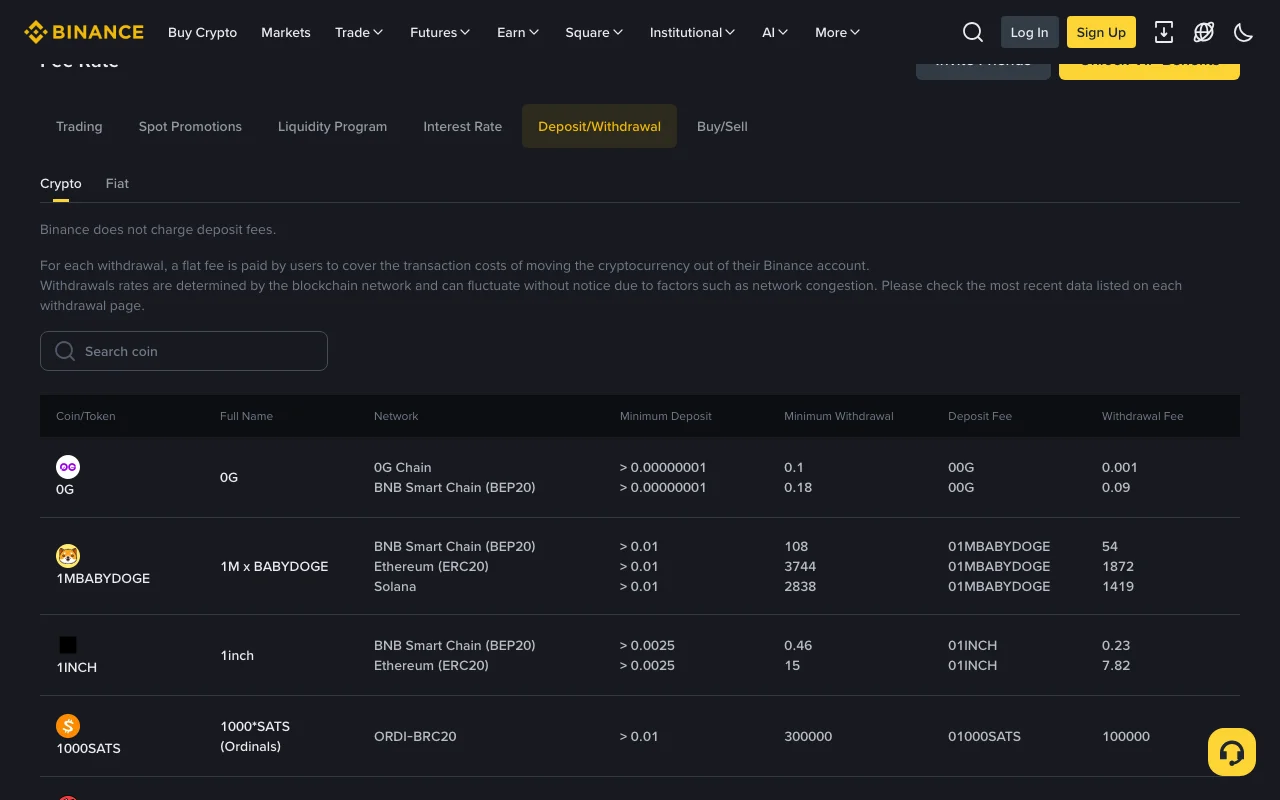
A crypto withdrawal from Binance costs a flat fee that is set per blockchain network and charged in the coin you are withdrawing. It is separate from trading fees. The same coin can cost very different amounts to move depending on the network: on 28 September 2026, withdrawing USDT cost 0.01 USDT on BNB Smart Chain (BEP20) and 1.5 USDT on Tron (TRC20). The figures in this article come from Binance's public fee page on that date. Fees change with network conditions, and the fee shown on your own withdrawal screen is the one you will actually pay.
Image: the Crypto tab of the fee page on 28 September 2026. Each line under a coin is a separate network with its own minimum and fee.
What the columns on the fee page mean
The page sits under Fee Rate → Deposit/Withdrawal → Crypto. Its header says Binance does not charge deposit fees, and that each withdrawal pays a flat fee covering the cost of moving the crypto out of your Binance account. That fee is set by the blockchain network and can change without notice, for example when a network is congested.
The table has these columns:
- Coin/Token and Full Name: confirm it is the asset you hold. USDT and USDC are different tokens, and some tickers look alike.
- Network: one line per network. A coin with three lines can be withdrawn on three networks.
- Minimum Deposit: deposits below this amount may not be credited.
- Minimum Withdrawal: set per network, so the same coin has several minimums.
- Deposit Fee: zero down the whole table, matching the header.
- Withdrawal Fee: the amount deducted, counted in the coin itself rather than in US dollars.
"No deposit fee" covers crypto arriving at Binance. The exchange or wallet that sends it can still charge its own withdrawal or network fee, and buying with a card, bank transfer or third-party provider is priced separately.
USDT withdrawal fees by network (28 September 2026)
Searching the table for USDT returned 19 networks. Fee and minimum are both in USDT:
| Network | Withdrawal fee | Minimum withdrawal |
|---|---|---|
| BNB Smart Chain (BEP20) | 0.01 | 5 |
| Plasma | 0.012 | 5 |
| opBNB | 0.015 | 5 |
| Kaia | 0.02 | 5 |
| AVAX C-Chain | 0.04 | 5 |
| Optimism | 0.04 | 3 |
| CELO | 0.05 | 5 |
| Polygon POS | 0.07 | 5 |
| Aptos | 0.1 | 3 |
| Asset Hub Polkadot | 0.1 | 5 |
| Scroll | 0.1 | 5 |
| Tezos | 0.1 | 5 |
| NEAR Protocol | 0.2 | 5 |
| KAVAEVM | 0.2 | 5 |
| Ethereum (ERC20) | 0.3 | 5 |
| Solana | 0.3 | 5 |
| The Open Network (TON) | 0.3 | 3 |
| Arbitrum One | 0.4 | 3 |
| Tron (TRC20) | 1.5 | 5 |
That day, TRC20 was the most expensive USDT network in the table, and Ethereum (ERC20) cost a fifth of it. If you picked up the idea that TRC20 is the cheap way to move USDT and Ethereum the costly one, check the current table before relying on it. Binance adjusts these fees as network costs move, so a ranking copied from an older guide or screenshot may no longer hold.
Other coins: the gap can be far wider
The first rows of the same table on the same day:
- 1INCH: 0.23 1INCH on BEP20 and 7.82 on Ethereum (ERC20), about 34 times as much. The minimum withdrawal was 0.46 on BEP20 and 15 on ERC20.
- 1M x BABYDOGE: 54 on BEP20, 1,419 on Solana and 1,872 on ERC20, with minimums of 108, 2,838 and 3,744.
Because the minimum changes with the network, an amount you can withdraw on one chain may be below the minimum on another. Search for your own coin and compare every line it has; the first row of the table is simply the first coin in alphabetical order.
Why a flat fee hurts small withdrawals
The fee is the same whether you withdraw 20 USDT or 2,000. Using the TRC20 fee of 1.5 USDT:
- withdraw 20 USDT: 1.5 is 7.5% of it, and 18.5 USDT arrives;
- withdraw 100 USDT: the fee is 1.5%;
- withdraw 1,000 USDT: the fee is 0.15%.
The same 20 USDT on BEP20 costs 0.01, or 0.05%.
Five small withdrawals pay the fee five times; one larger withdrawal pays it once. That is not a reason to skip a small test when the address or network is new to you. A test only helps if it meets Binance's minimum withdrawal and, after the fee, still meets the receiving side's minimum deposit. Wait until the test is credited before sending the rest. A successful test does not cover later transfers either: check the address, network and memo again each time.
The cheapest network only works if the receiver supports it
Before choosing a network by fee, check three things:
- The receiving exchange or wallet lists that exact asset and network for deposits. BEP20, ERC20, Arbitrum One, Optimism, Polygon POS and AVAX C-Chain all use the same 0x address format, so an address that looks valid tells you nothing about which network the receiver will credit. Funds sent on an unsupported network may not arrive and may not be recoverable.
- The network is open for withdrawals. During maintenance, Binance suspends withdrawals on that network and the withdrawal screen shows it as unavailable.
- The amount left after the fee meets the receiver's minimum deposit. Use the amount to be received on the confirmation screen, not the figure you typed in.
For the receiving-side checks, including memos, address format and tracking a TxID, see what to check on the receiving side before a Binance withdrawal. Blockchain transfers cannot be reversed once sent.
Reading a fee in coin units
For USDT and USDC, the fee is close to its dollar value. For other coins, multiply it by the current price before deciding whether a withdrawal is worth making; a fee of 1,419 units of 1M x BABYDOGE and a fee of 0.001 0G are not comparable until you convert them. When you are comparing networks for the same coin, the raw numbers are enough.
Trading fees are charged separately; how Binance spot trading fees are calculated covers maker, taker and the BNB discount, which does not apply to withdrawal fees. If a leftover balance is too small both to sell and to withdraw, why small orders and leftover balances get rejected explains the order-side limits.
Source: Binance Deposit & Withdrawal Fees (Crypto), viewed 28 September 2026.