
Fees & Transfers
How Binance futures fees are calculated: open, close and funding
Binance futures commissions are charged on executed contract value, so opening and closing each carry their own fee. Funding is a separate payment and needs its own check.
A futures trading fee is charged on the value of contracts executed, not just the margin deposited. Opening and closing are separate executions. Perpetual funding is a separate payment again.
This is an advanced guide for people checking a futures bill. Leveraged positions can be liquidated and lose all posted margin. If you only need to buy or transfer crypto, start with the spot-fee and transfer guides.
Start with the contract you are trading
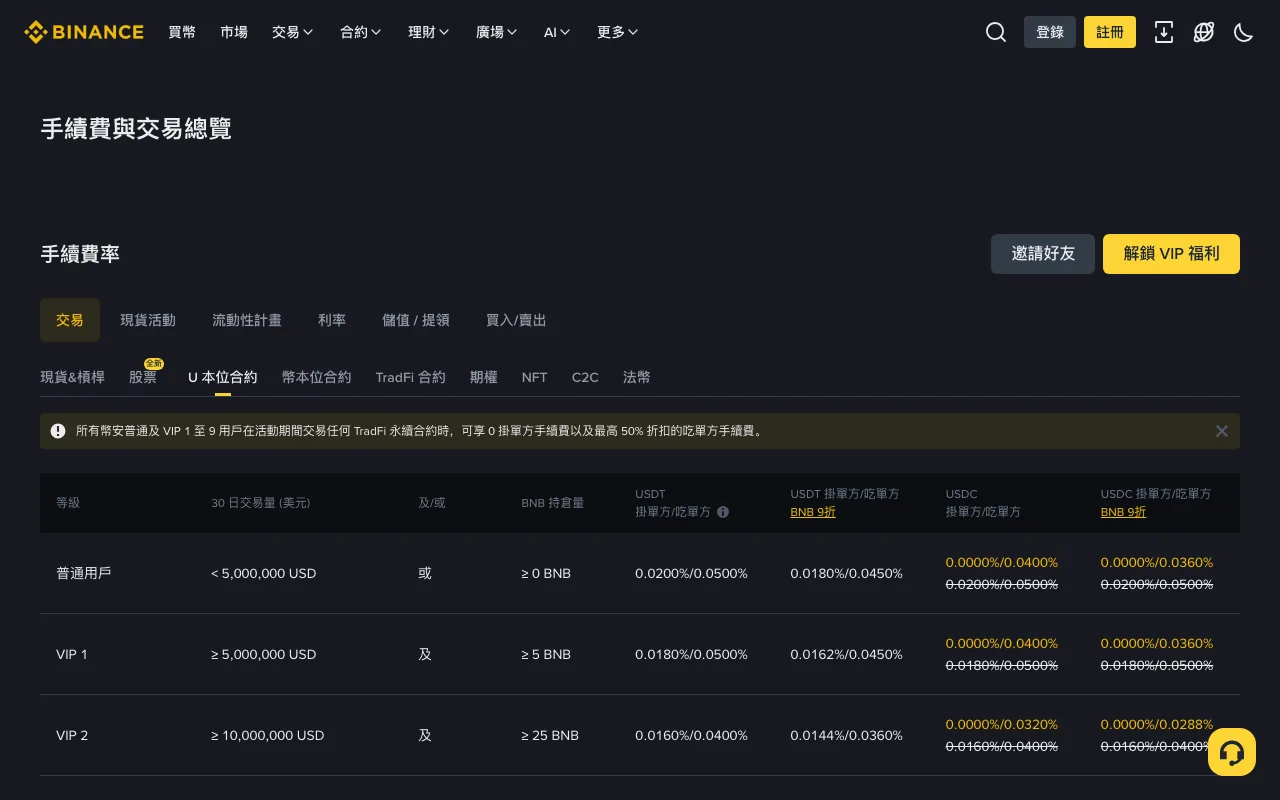
On 5 September 2026, the regular-user USDT maker/taker row in Binance's USD-M fee table showed 0.0200% / 0.0500%. The BNB-discount column showed 0.0180% / 0.0450%, matching the 4 September screenshot below.
These are the general rates from Binance's fee page, and your own account's rate may differ. Check USDC, COIN-M and other contracts separately, and remember that a promotional rate can end. A limit order that executes immediately may be a taker, so the order label alone does not determine the fee.
Calculate both sides of the trade
For this example, assume a USDT linear contract, taker execution on both sides, a 0.0500% rate and no discounts.
Fee = executed contract value × 0.0005.
An opening execution worth 10,000 USDT costs 5 USDT. If the closing execution is worth 10,500 USDT, its fee is 5.25 USDT. Total trading fees are 10.25 USDT, before funding or any other applicable charge. Do not automatically reuse the opening value for the closing calculation.
With partial fills, calculate each execution separately and add them. A mix of maker and taker fills may use different rates. Compare the result with the fee amount and charged asset in trade history.
A partial close has its own cost
You do not have to close the whole position at once for a closing fee to arise. In another hypothetical USDT linear-contract example, assume a 6,000 USDT opening execution at a 0.0500% taker rate. The opening fee is 3 USDT. Later, one portion closes for 2,100 USDT and the rest for 4,300 USDT at the same assumed rate. Those closing fees are 1.05 and 2.15 USDT, bringing the total to 6.20 USDT.
Each exit is charged on its own executed value. Likewise, the single price shown in the position summary may not be where every fill occurred. Use the trade records for what executed, and keep funding entries separate.
Does increasing leverage always increase the fee?
No. If the executed position remains worth 10,000 USDT and the fee rate stays unchanged, changing a leverage setting does not itself double the trading fee. Required margin and risk conditions change, but the same executed value still produces the same fee calculation.
Fees increase when leverage is used to trade a larger position with the same margin. “Margin multiplied by leverage” only shows capacity. For the fee, use the executed quantity and price of the position you actually opened.
Why a small published percentage can look large against margin
Take the earlier 10,000 USDT execution and its hypothetical 5 USDT opening fee. Against 500 USDT of posted margin, that fee is 1% of the margin. Against 1,000 USDT, it is 0.5%. In both cases the trading-fee rate on the executed value is still 0.0500%.
Those margin figures are illustrations only. Before comparing percentages, be clear whether each one refers to your margin or to the contract value. A fee calculator that silently switches between them can make the exchange's rate appear to have changed when it has not.
Fees also use money that would otherwise remain in the account. Do not treat the entire posted amount as a cushion solely for an adverse price move, especially if there are funding deductions or other positions drawing on the same balance.
Funding is charged separately
Perpetual contracts settle funding at specified times. Depending on the rate and position direction, a holder may pay or receive it. Check whether the position crosses the relevant settlement time. Different contracts can have different schedules; do not assume every contract settles every eight hours.
The trading-fee rate of 0.0500% is not a daily holding charge or a funding rate. Check the contract's funding information before estimating the cost and the account's transaction history afterward. Liquidation-related charges, if applicable, must also be checked under their own rules.
Read the funding sign and settlement record
Binance's funding-rate explanation describes payments between long and short holders. With positive funding, longs pay shorts; negative funding reverses that direction. For a USD-M linear position, the calculation uses the position value based on mark price at settlement, which can differ from the value when you opened it.
Assume, only for illustration, that the relevant settlement value is 8,000 USDT and the funding rate is +0.0100%. The payment magnitude is 0.80 USDT: a long pays and a short receives under those assumptions. At -0.0100%, the direction reverses. Neither example predicts the next rate.
Record the contract, position direction, applicable settlement time, settled rate and the payment in transaction history. A rate displayed before settlement can differ from the final charge. Do not estimate a day's funding by multiplying one displayed rate by three unless the actual contract schedule and all those rates justify it. Don't count on a last-second close to avoid a payment, because order execution and settlement timing cannot be guaranteed.
Reconcile fees without subtracting them twice
Suppose a hypothetical completed trade has 24 USDT of price profit before costs, 6.20 USDT of trading fees and 0.80 USDT of funding paid. With no other charges, its result is 17 USDT. If funding were received instead, the result would be 18.60 USDT. This is bookkeeping arithmetic only.
Before doing that calculation with your own history, read what the displayed profit figure includes. A figure already net of commission must not have commission subtracted again. Keep the price result, trading commissions and funding payments in separate columns until you know how the platform's summary treats them.
Trading less frequently may reduce the number of commissions, but holding a position longer changes exposure and may cross additional funding settlements. Switching to a maker order also changes execution certainty. Neither choice should be made on the commission column alone. Apart from fees, a leveraged position can lose money through price moves and liquidation.
Check the actual BNB deduction
In the USDT futures fee table, the BNB column gives a 10% reduction, unlike the spot table's 25%. Eligibility, the relevant setting and sufficient BNB must all be checked. A confirmed rate of 0.0450% on a 10,000 USDT taker execution would cost 4.50 USDT. That is a conditional example; don't trade more or buy an asset solely for a fee discount.
Do not stack an unconfirmed referral benefit on top of a spot discount and apply the result to futures. Use the actual charge in the account. Leverage can cause liquidation and loss of all posted margin; cross-margin settings can expose additional account funds. Read the Binance risk warning before using such products. For spot trading, see our fee calculation guide.